
The Detective's Guide to Mystery Sudoku: Why Solving Cases Changes Everything
The Detective's Guide to Mystery Sudoku: Why Solving Cases Changes Everything
You sit down with a puzzle book. You see a grid of numbers. You begin to solve. Minutes pass. An hour passes. You finish. You close the book.
And you feel... nothing.
This is the hollow experience of traditional puzzles. They're intellectually satisfying, sure. Your brain gets a workout. But there's no story. No stakes. No reason to care beyond the mechanical pleasure of filling in the right numbers. It's like playing chess against a computer instead of a friend. Technically the same game, but emotionally empty.
Now imagine this instead.
You open a book and read a short story. A museum heist. A woman discovers her boyfriend has secrets. A high-tech conspiracy unfolds. You meet nine suspects, each with a name, a number, and a motive. As you read, clues jump out at you. Contradictions. Details that don't add up. Red herrings designed to mislead. Your mind is already working, already investigating.
Then you turn to the puzzle.
You solve the Sudoku grid. You find the missing digit in the "Evidence Cell." That number corresponds to a suspect. As the final number clicks into place, the mystery completes. The puzzle doesn't just provide mental satisfaction. It provides closure. Justice. The feeling that logic itself has revealed the truth.
This is the magic of mystery Sudoku. It's not just a puzzle. It's an experience. And once you understand how it works, you understand why so many people are discovering that this is the only way they want to solve puzzles anymore.
The Shift: From Numbers to Narratives
For decades, Sudoku has been a staple of puzzle culture. It's clean. It's logical. It's satisfying in a mathematical way. But if you've ever solved hundreds of traditional Sudoku puzzles, you know the truth: they all feel the same. Different numbers. Same experience. After a while, you're going through the motions.
Mystery Sudoku disrupts this formula completely.
The game is still Sudoku. The logic is unchanged. But now you're not solving a puzzle for the sake of solving a puzzle. You're solving a puzzle to catch a criminal, to uncover a lie, to understand a relationship. The grid becomes evidence. The numbers become clues. Your brain isn't just engaged in logic. It's engaged in narrative, emotion, and detective work.
This changes everything psychologically.
When you solve a traditional Sudoku, you feel accomplished. When you solve a mystery Sudoku, you feel like a detective. You've cracked a case. You've brought justice. You've used your mind not just to follow rules, but to pursue truth. The satisfaction runs deeper because it means something.
And here's what's fascinating: this added meaning doesn't make the puzzle harder. It makes you want to keep solving. Your brain doesn't get tired because your mind is invested. You're not filling in numbers. You're solving a mystery. The entertainment value transforms the entire experience.
The Journey Begins: Entry Into the Evidence Cell
If you're new to mystery Sudoku, there's a perfect place to start.
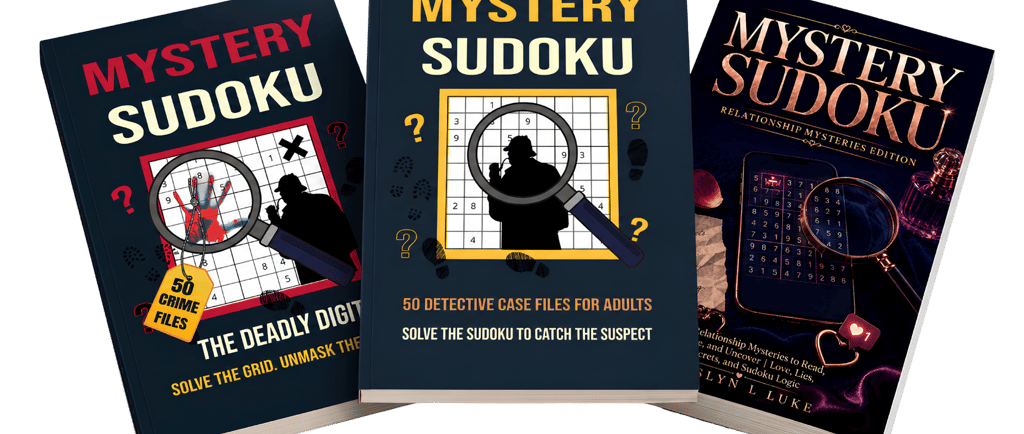
Mystery Sudoku: 50 Mystery Sudoku Puzzle Challenges is the gateway. Fifty unique cases, each designed to be accessible whether you're a Sudoku veteran or someone picking up a puzzle book for the first time. The cases are thematically simple: jewelry heists, museum thefts, corporate sabotage. Classic detective fare. Each case gives you a "Who, What, and Where." Each presents nine suspects, each with a number from 1 to 9.
You read the brief narrative. You identify the suspects. You notice the clues. Then you solve the Sudoku grid, and the missing digit reveals the culprit.
What makes this book particularly brilliant is that it doesn't pretend to be something it's not. The puzzles are easy-level. The cases are straightforward. But the experience is so much richer than a traditional Sudoku that you won't notice the difficulty level. You'll be too immersed in the mystery.
This is the hook. This is where readers discover that puzzles can be entertaining in ways they never expected. Many solvers report that they finish this book thinking, "I didn't know puzzles could be like this." They speed through cases. They feel motivated. They experience that rare combination of relaxation and engagement.
And then they want more.
The Escalation: When You're Ready for the Real Investigation
After you've closed your first fifty cases, something shifts. You've tasted what mystery Sudoku can do. You've felt the satisfaction of solving a narrative through logic. You understand the rhythm. And now you want the stakes higher.
This is when Mystery Sudoku: 50 Detective Case Files for Adults, Find the Deadly Digit becomes essential.
This isn't just a sequel. It's a completely different investigation.
The cases here are darker, more cinematic, more complex. You're not solving simple robberies. You're investigating elite conspiracies, high-speed disasters, subterranean tech heists. The narratives are richer. The suspects are more nuanced. The clues are more layered. The stakes feel real.
But the brilliance is the progression built into the book itself.
The fifty cases are divided into three phases: Rookie Inspector (easy), Lead Inspector (medium), and Master Inspector (hard). This means you're not jumping from easy to overwhelming. You're naturally advancing. Your confidence grows. Your detective skills sharpen. By the time you reach the hardest cases, you're thinking like an experienced investigator. You see patterns. You catch contradictions. You trust your instincts.
The puzzles mirror this progression. The early cases warm you up. The middle cases challenge you. The final cases demand everything you've learned. And because they're embedded in narrative, you don't experience it as "hard." You experience it as "the case is getting more complex, and I'm ready for it."
This is where many solvers realize that mystery Sudoku isn't just entertainment. It's a form of mental development. Each case solved is a mini-workout in deductive reasoning, logic, and attention to detail. You're not just passing time. You're building real cognitive skills while being thoroughly entertained.
Readers who go through this progression often report that their ability to focus improves in their daily lives. They catch lies in conversations. They notice details they used to miss. They approach problems differently. All because they've spent fifty cases training their investigative mind.
The Deepening: When You Want Meaning With Your Mystery
But here's something even more powerful that happens for many readers.
After solving fifty crime cases and building their detective muscles, they discover that not all mysteries are about external crimes. Some are about internal ones. Some are about relationships. Some are about the lies we tell ourselves and each other.
This is where Mystery Sudoku: 50 Relationship Mysteries to Read, Solve, and Uncover becomes transformative.
This book takes the mystery Sudoku format and applies it to something far more personal. The cases aren't about criminals. They're about women at crossroads. A boyfriend's secret phone. A best friend's sudden silence. A lover's confession that might be a lie. Cash withdrawals that don't make sense. Conversations that contradict what you were told.
Each case is a full narrative, roughly three hundred words. You meet nine suspects. But these aren't suspects in a traditional sense. They're people with different interpretations, different loyalties, different versions of the truth. You read the story. You spot the clues. You notice the contradictions.
Then comes the Investigation Board. Before you even touch the Sudoku grid, you eliminate suspects based on logic and the clues you've found in the narrative. You're not just solving a puzzle. You're actively investigating, building a case, making deductions.
Then you solve the Sudoku. The missing digit reveals the answer. And suddenly, you understand. The boyfriend is or isn't cheating. The friend is or isn't lying. The truth is revealed, and it's confirmed by logic itself.
What's remarkable about this book is the emotional resonance. These aren't abstract mysteries. They're human mysteries. They're stories about trust, betrayal, protection, fear, and clarity. Many readers report that solving these cases feels like processing their own experiences. Like using logic to untangle emotional complexity. Like having a form where they can practice understanding human behavior.
The puzzle doesn't just solve the mystery. It validates your instincts. You read the case, you suspect someone, the logic confirms your suspicion. Or you're surprised. Or you realize you missed something important. In every case, you're not just entertained. You're learning something about how to read people, how to notice details, how to distinguish truth from lies.
This is puzzle solving that has meaning beyond the puzzle itself.
The Complete Journey: Why These Three Books Form a Perfect Progression
Here's what's beautiful about The Evidence Cell Sudoku Mysteries as a series.
Book 1 is the invitation. It's "puzzles can be this engaging." It's the discovery that narrative plus logic equals something powerful. Most readers fly through these fifty cases, surprised by how satisfying they are.
Book 2 is the deepening. It's the step from curiosity to skill. It's the realization that mystery solving is actually a learnable ability. The progression from easy to hard means you're training your mind without even realizing it. By the end of fifty cases, you're sharper, more focused, more confident in your deductive abilities.
Book 3 is the meaning-making. It takes the skills you've built and applies them to something that matters. It says, "Your ability to solve mysteries, to notice details, to think logically about complexity, that skill is valuable in understanding real human relationships." It's puzzle solving that reaches beyond the puzzle.
Together, these three books create a complete experience. You're not just collecting puzzles. You're taking a journey. You're developing skills. You're having a conversation with yourself about how you see the world, how you solve problems, what you value in mystery and truth.
And that's why readers come back to them again and again.
Finding Your Entry Point
Now, you might be wondering: which book should I start with?
The answer depends on who you are.
If you've never tried mystery Sudoku and want to understand the concept before committing, start with Book 1. It's the clearest introduction. The narratives are straightforward. The puzzles are accessible. By the time you finish fifty cases, you'll know exactly how this works and whether you want to go deeper.
If you're already an experienced Sudoku solver and you want something that challenges your skills immediately, start with Book 2. The progression within the book means you're not overwhelmed, and the more complex narratives and harder puzzles will feel like a natural evolution from traditional Sudoku. This book rewards your existing skills and builds on them.
If you're someone who loves stories and emotional depth, or if you're someone who's curious about how logic and intuition work together, start with Book 3. The relationship mysteries will hook you in a completely different way. You won't experience this as a puzzle book. You'll experience it as a form of self-exploration that happens to involve Sudoku.
Or here's what many readers do: they start with Book 1 to understand the format. They move to Book 2 to build their skills. They end with Book 3 as a completely different experience. They read all three because they each offer something different.
The Real Magic
At the end of the day, the real magic of mystery Sudoku isn't about the puzzles. It's about transformation.
You start out wanting a way to pass the time that's better than scrolling. You want to exercise your mind. You want to feel focused instead of scattered.
And then something unexpected happens. You realize you love detective work. You realize you're good at reading clues. You realize that your ability to notice details, to think logically about complexity, to solve problems systematically, that these are real skills that matter.
You finish a book and you feel like you've done something meaningful. Not just entertained yourself. Accomplished something. Developed yourself. Grown.
This is what mystery Sudoku does. It makes puzzle solving meaningful. It makes mental exercise feel like purpose. It transforms a activity into an experience.
Start Your Investigation Today
You don't have to choose all three right now. You just have to take the first step.
Pick up Mystery Sudoku: 50 Mystery Sudoku Puzzle Challenges and discover what puzzle solving can be. Experience one case. Feel that moment when the numbers align and the mystery clicks into place. See if this is something that resonates with you.
If it does, if you find yourself thinking "I want more of this," then you'll be ready for the deeper cases in Mystery Sudoku: Deadly Digit, where the stakes get higher and the challenges get richer.
And if you discover that you love the feeling of using logic to understand complexity, then you'll reach for Mystery Sudoku: Relationship Mysteries, where the same skills apply to stories that matter in completely different ways.
All three books are available on Amazon, ready to transform how you experience puzzles.
Your detective journey is waiting. The evidence is all there. You just have to solve it.
Book 1: Mystery Sudoku: 50 Mystery Sudoku Puzzle Challenges for Adults https://www.amazon.com/dp/B0GJ5457XF
Book 2: Mystery Sudoku: 50 Detective Case Files for Adults, Find the Deadly Digit, Solve the Grid, Catch the Killer https://www.amazon.com/dp/B0GW8YSYXR
Book 3: Mystery Sudoku: 50 Relationship Mysteries to read, solve, and uncover https://www.amazon.com/dp/B0H23H868B